

St. Joseph the Worker Academy
The Mass
Traditional Mass shapes men through sacred arts, Latin, and architecture, embodying a masculine hierarchy and revealing the mystery of Gabbatha for perfect fatherhood.
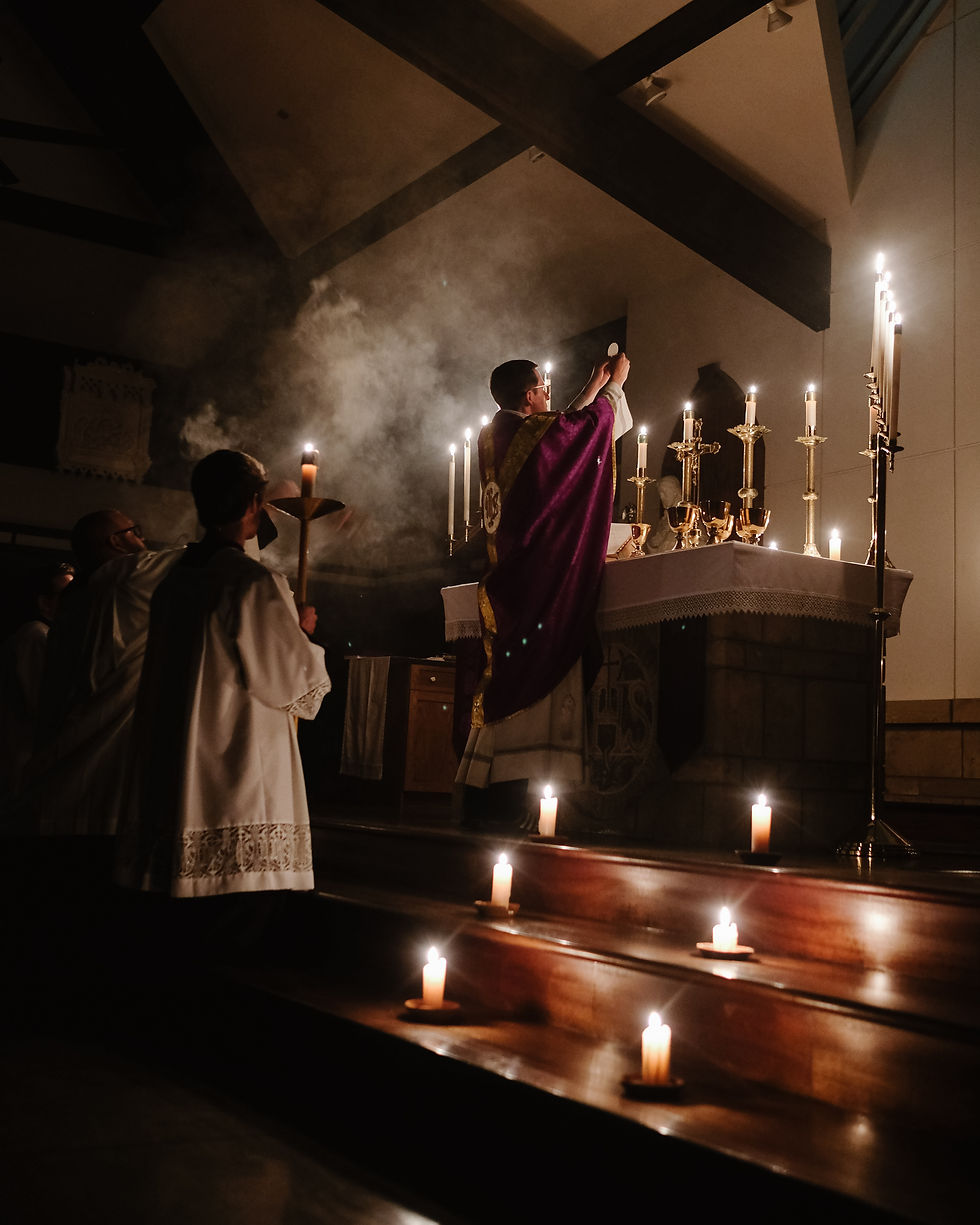
Since it is the "font and apex" of the Christian life, the Mass must in a certain sense be central to all of our actions. In respect to the education of men, however, it will have a particularly didactic as well as spiritual role and must have the most prominent place. As may be evident from all that has been said, it is the traditional form of the Mass that will be, in manifold ways, most suitable.
Since the modern Mass was defined by its creators as differing from the old precisely in its design for modern people, it cannot provide effectively the insights and connection to the lives and work of previous Christians which are contained in the old use. Any study of sacred music, of Latin, of architecture and building, of drama and poetry, of masculine virtue, finally of Christian culture itself, will lack its master key without the Mass of the Ages. A classical Catholic education, which intends to transmit the traditional treasures of the Church and make them a living reality will have a "Mass-shaped hole" if it is not constructed around the Mass which was the wellspring of inspiration for the works and history being studied.
More than that, however, it may be evident that the old use is a form peculiarly suited to our project of forming men. In its transcendent beauty manifested through its music, poetry, drama, etc., it contains a capacity to form the imagination for Heaven, far beyond any other work of art.
The dramatic play of the Mass is not useful for any purpose but its own action. It is inefficient, full of diversions and repetitions. It is not specifically fashioned to serve the sensibilities of a community, further catechical work, or aid any other project, though it may well result in making positive contributions to each of those goods.
In the Usus Antiquior, the preeminence of the Father is manifest throughout. From the first moments of the Mass, with the ranks of the servers and prayers at the foot of the altar, it embodies a masculine hierarchy in action. The cooperation of men facing together, engaged in holy work, provides a perfect model of male friendship.
In the Old Rite, the Man of Gabbatha is most clearly beheld, in His mystery, His sovereign silence, and His sacrifice. If it is our project to form sons according to the image of perfect fatherhood, is there any better way to pray than with the Son who is the perfect image of the Father?